
Australia's new-vehicle market could top 1.4 million by 2035 – CarExpert
As Australia's population grows, the new-vehicle market is likely to grow with it… and Chinese brands, EVs and PHEVs may be big beneficiaries.
Alborz Fallah
Publisher
Alborz Fallah
Publisher
Australia just recorded 1,241,037 new-vehicle sales in 2025, but what happens next isn’t only about product cycles and supply chains. Over the next decade, the biggest structural inputs will be population growth, ongoing shifts in where vehicles are built, and the speed at which electrified powertrains displace conventional ones.
Australia’s population at June 30, 2025 was 27.6 million people, according to the Australian Bureau of Statistics (ABS).
The ABS also stresses its long-run population figures are projections, not forecasts – they illustrate what would happen if assumed fertility, mortality and migration settings occur. That matters, because any “next decade” vehicle story has to be framed as scenario-based, not certain.
On the ABS 2022-base projections, Australia’s population is shown rising to 29.3–29.9 million by 2030 (low to high) and to 29.9–32.0 million by 2035 (low to high).
CarExpert can save you thousands on a new car. Click here to get a great deal.
If Australians kept buying new vehicles at roughly the same per-capita rate as 2025, the arithmetic implies a larger total market even without any change in “cars per person”.
Using the 2025 result (1,241,037 sales) and the ABS June 30, 2025 population (27.6 million), Australia bought roughly 44.9 new vehicles per 1000 people in 2025.
Applying that 2025 rate to projected population totals gives a simple scale reference:
Those aren’t predictions – they’re what the market size would look like if the 2025 sales-per-person rate held and population grows along those paths.
The manufacturing-origin mix has moved quickly over the past decade, especially in the 2020s.
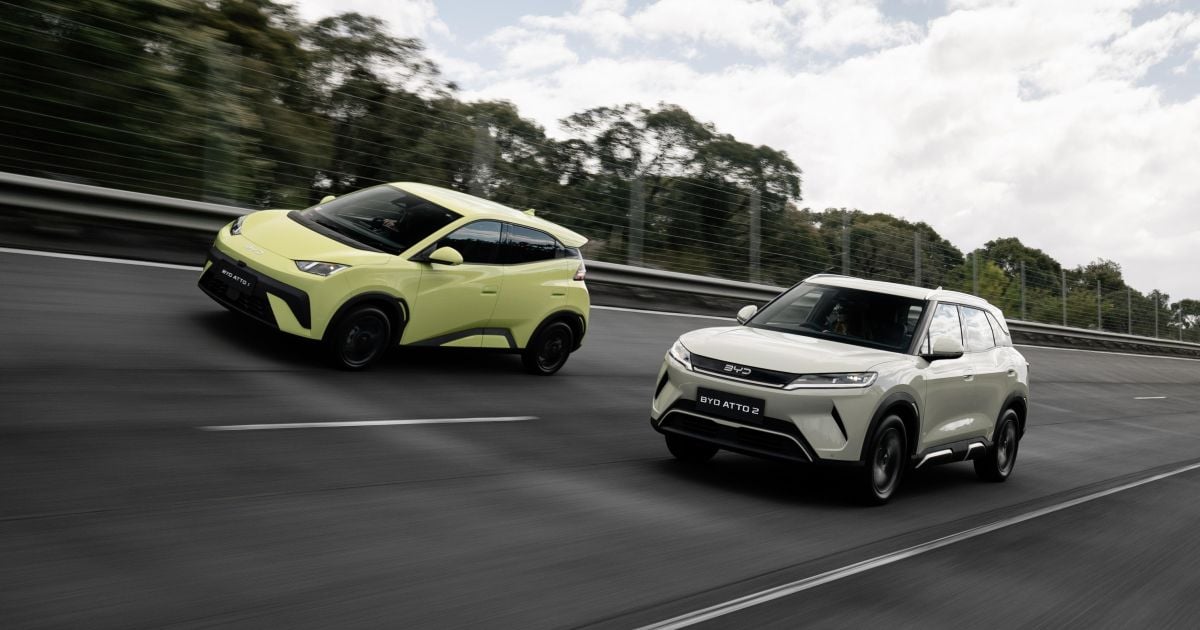
Chinese-built vehicles increased from 2320 units in 2015 (about 0.2 per cent of the market) to 252,928 in 2025 (about 20.4 per cent).
Over the same period, Japan remained the largest single source by volume in both years (335,288 in 2015 and 358,981 in 2025), while Thailand moved from 249,804 in 2015 to 249,958 in 2025.
The key point isn’t that Japan and Thailand disappeared, it’s that China rose into the top tier without the others collapsing to zero. That’s another way of describing a more complex, more globally distributed supply picture.
The last decade also captured the shift from niche EV sales to a meaningful chunk of the market.
In the passenger/SUV/light-commercial “light vehicle” categories:
If you broaden the definition to include hybrids and hydrogen, total “electrified” sales in 2025 reached 355,889, or 29.8 per cent of light-vehicle sales.
It’s also notable that the rise of electrification and the rise of China as a source country have happened at the same time: China’s origin share climbed sharply in the same period that plug-in share accelerated.
Here’s how sales could grow in the future, taking into account how sales have already increased.
China origin share (actual → straight-line scenarios)
Plug‑in share of light vehicles (actual → straight-line scenarios)
Those ranges are not “what will happen”, but they do show the scale of change embedded in the last few years of data: if growth rates don’t slow materially, the mix in 10 years could look dramatically different.
China’s rise isn’t purely visible in origin tables; it’s visible in the top of the sales charts too.
In 2025, multiple China-linked marques were already major volume players:
That matters for a next-decade view, because once brands become entrenched at this level, they influence fleet buying, used-car supply, service networks, and price-setting across segments.
If Australia’s population grows along the ABS projected paths, and if recent “China share” and “plug‑in share” trends even partially hold, the 2030s could be defined by a larger total market, a much higher electrified mix, and a bigger share of vehicles sourced from China with the caveat that the ABS population numbers are projections, not forecasts, and market mix rarely moves in straight lines forever.
Alborz Fallah is a CarExpert co-founder and industry leader shaping digital automotive media with a unique mix of tech and car expertise.
William Stopford
7 Minutes Ago
Damion Smy
3 Hours Ago
William Stopford
4 Hours Ago
Damion Smy
4 Hours Ago
Matt Campbell
5 Hours Ago
William Stopford
5 Hours Ago
William Stopford
7 Minutes Ago
Damion Smy
3 Hours Ago
William Stopford
4 Hours Ago
Damion Smy
4 Hours Ago
Matt Campbell
5 Hours Ago
William Stopford
5 Hours Ago
7 Months Ago
7 Minutes Ago
3 Hours Ago
4 Hours Ago
5 Hours Ago
2 Days Ago


