Cheapest Cars to Insure in the UK in 2026 – Carwow
February 04, 2026 by Ryan Hirons
There are many ways in which you can find a cheaper car insurance policy, whether it’s having a ‘black box’ data recorder fitted, which monitors your driving style, or by simply moving to Leeds or Sheffield (the most affordable regions of the UK for car insurance costs, according to Confused.com). There’s a potentially easier way, though — get yourself one of the cars on this list. These are the 10 cars on sale in the UK right now which are in the lowest insurance groups.
Those groups are jointly decided upon by the vehicle safety and security experts at Thatcham Research and the Association of British Insurers. It’ll be no surprise that the insurance groups take the car’s engine size and performance into account — hence why there are so many small-engined cars on this list — but there are other criteria, such as the cost of replacement parts, the cost of repairing it if it’s involved in an accident, the cost of replacing the car entirely if it has to be written-off, what active safety systems the car has, and it’s anti-theft security.
Of course, insurance also takes you, the driver, into account — your age, your driving record, your no-claims bonus, etc., but the car itself makes up a significant part of what insurance actuaries reckon you should be charged. So, buy wisely, and you’ll keep your costs under control.
Carwow intensively tests every new car on sale, whether they’re expensive or cheap to insure, so that we can give our expert recommendations. We drive cars on the road and look at the individual strengths of each model, so alongside recommending these cars as being cheap to insure, you can also trust our opinion on what they’re like to own, too.
Remember, you can buy a brand new or used car right here on Carwow. And you can sell your car, too. We’re here to help you through every step of your car-changing journey.
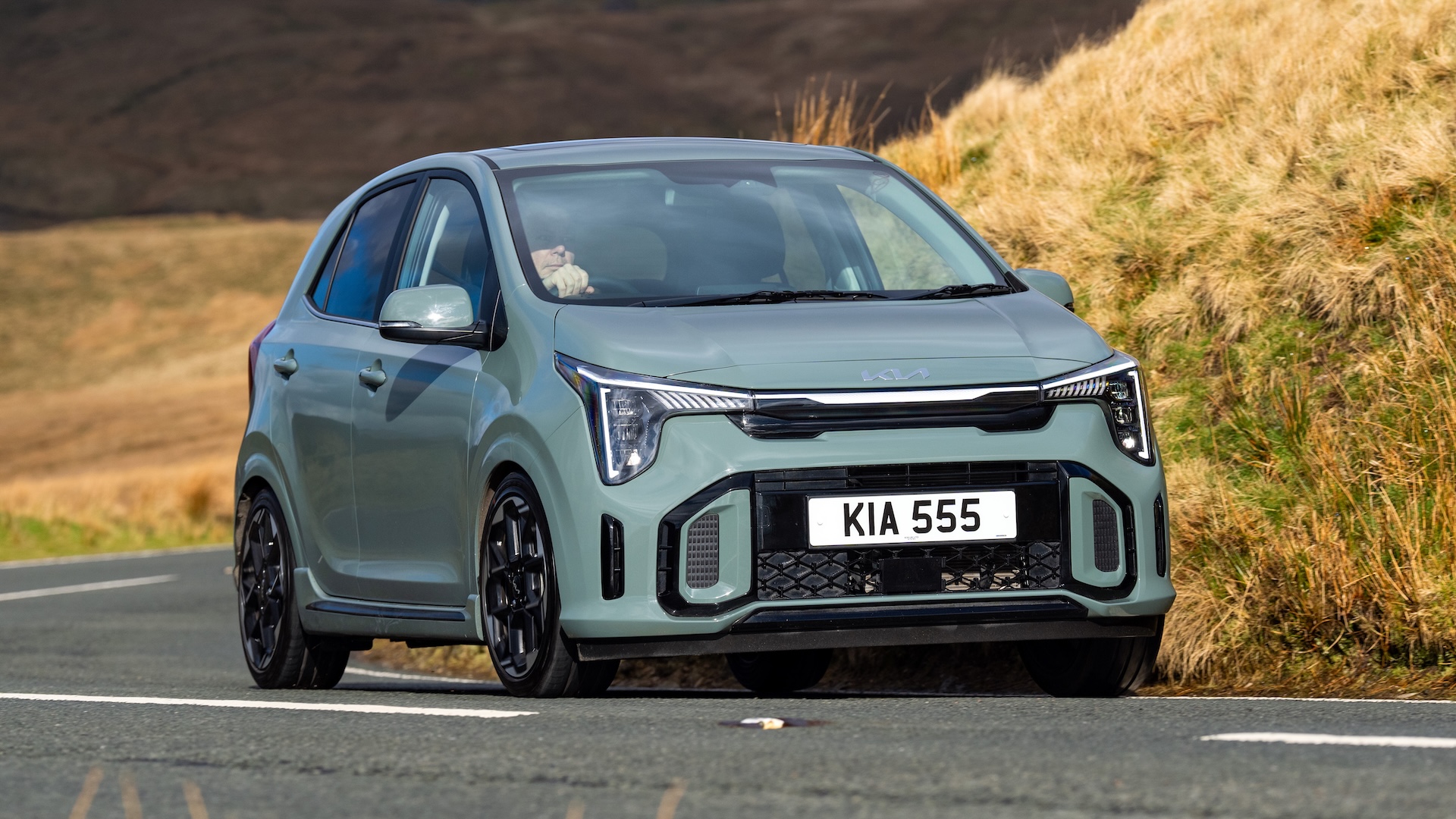
As pretty much the only combustion-powered city car still standing, the Kia Picanto will become a de facto choice for many. Thankfully it also continues to be a very cheap one to insure.
The bad news is that going for the cheapest-to-insure Pure Auto model means dealing with one of the most horrible automatic gearboxes ever produced. You can opt for a manual, but that will bump your insurance groups up a little and will have an effect on your premiums as a result. We’d take the hit for the sake of our own well-being.
The Picanto offers remarkable fuel economy (you might crack 60mpg if you’re gentle on the throttle) thanks to low power and its low weight, though longer journeys aren’t the Picanto’s friend. The upright driving position starts to get uncomfortable after a while, and it’s not the quietest car around. For nipping in and out of town, though, or on country roads, it’s actually surprisingly good fun. The tiny 9.4-metre turning circle makes the Picanto a doddle to park in tight spaces.
The cabin is basically quite cheap, but doesn’t feel downmarket, and the 255-litre boot is actually quite generous for such a small car.
Shopping in the bargain bin of insurance costs doesn’t necessarily mean having to compromise for a bad car. After all, this VW Polo is in Group 3 for insurance, which means that while it’s not going to quite have the cheapest premium going, it won’t be far off, and you’re getting a pretty posh car.
That said, you will have to go for the cheapest Polo of them all, the entry-level Life, which uses the most basic engine in the entire Volkswagen lineup. That’s a 1.0-litre three-cylinder with just 80hp, and it really does feel that slow. More powerful engines are available throughout the range, but naturally, those fall into higher and more expensive insurance groups.
Equipment levels take a hit as well, but the Life comes with all-round electric windows and digital instruments, so the classy and well-made cabin doesn’t feel too bare.
Space is excellent front and rear, although the 351-litre boot isn’t as big as that of some other cars in its class, notably the mechanically identical Skoda Fabia.
To drive, the Polo is very slick and smooth. That little engine might not have much in the way of power, but it makes a sweet little three-cylinder off-beat sound, while the Polo’s comfort over bumps is excellent, helped by the small 15-inch alloy wheels.
Other cars in this class may be more fun to drive, but the Polo represents the best in safe and sensible motoring (and indeed it’s very safe, with lots of standard safety equipment and an excellent Euro NCAP crash test rating).
Great news! The Dacia Sandero is still one of the cheapest new cars to insure in the UK.
Granted, that does mean sacrificing most creature comforts and opting for the base-spec Expression model, a car so basic you’ll need to use your phone as the infotainment system. That said, you’re still getting a lovely mechanical heart at the core of that. Although the 1.0-litre three-cylinder engine isn’t exactly oozing performance with 90hp on tap, it’s not painfully slow and is paired up with a reasonable six-speed manual gearbox.
Steering is light, it’s easy to manoeuvre around town, and because the car doesn’t weigh a whole lot, you can achieve fuel economy returns north of 50mpg if you’re gentle with it. Oh, and it’s cheap to buy upfront.
You can opt for a higher-spec Sandero, which brings a dedicated screen with a reversing camera, but insurance groups will jump up quite notably as a result.
Why is the Skoda Fabia a full insurance group worse off than a VW Polo with the same 80hp engine and same basic structure? It’s not entirely clear, but whatever the reasons, the Fabia is that little bit pricier to insure than the Polo. However, given that you’re saving over £1,000 on the purchase price, that should outweigh any potential insurance penalty.
Being the same as the Polo under the skin means that this Fabia 1.0 MPI shares the non-turbo 80hp engine, so you’re looking at a glacial 15.7 seconds to get from standstill to 62mph, but then the upside of that is that if you’re taking things gently, then you’ll get better than 50mpg fuel economy.
Inside, the Fabia actually manages to look a little more interesting than the VW with a dashboard that’s more stylish, if perhaps not quite as posh-feeling as the Polo. Space is excellent, and the Fabia has an even bigger boot than the Polo’s, with its 380 litres of luggage space matching bigger, more expensive hatchbacks. You do have to pay extra for an adjustable boot floor, though.
The Fabia is nippy and easy to turn in town, and it’s quite refined when you’re at higher speeds, with very little in the way of wind noise on the motorway. The suspension is nice and smooth, helped by the small standard wheels on this basic model, so you’ll not get jostled or bumped around in town, and the Fabia feels well-planted when tackling country roads. Fun? Not quite, although it’s not totally dull either.
It’s often the case that if you want the best value car, you actually need to buy a van, and so it proves here. The Volkswagen Caddy is a spacious compact van when you buy it as a commercial vehicle, but spend a bit extra to get rear seats and windows, and suddenly you have an affordable family-sized car with reliability and cheap running costs on its side, as well as decent Group 8 insurance costs. Certainly, on a cabin-space-per-insurance-premium rating, the Caddy MPV is basically unbeatable.
To get the lowest possible insurance group, you’re getting the most basic engine offered; the 1.5-litre TSI petrol four-cylinder unit has only 116hp, but it’s reasonably quick off the mark thanks to a turbocharger, and so 0-62mph takes 11.9 seconds, making the Caddy one of the quickest vehicles here. Probably the only time that sentence has ever been written, though.
The standard version has seats for five (seven seats cost extra and bump you up a few insurance groups), but there are three individual seats in the back, which is excellent if you’ve got a few kids. Meanwhile, sliding doors make access dead easy, and the massive boot holds more than 1,200 litres, which is more than many cars can carry with their back seats folded down. The Caddy manages that with all the seats in use.
“Hang on, isn’t there a new Renault Clio now?” You may be saying, having read our review of the 2027 version of the hatchback recently.
Well, yes, but also no. See, that car is now on sale in Europe, but the new version of the Renault Clio won’t be coming to our shores until next year. Blame Renault’s uncertainty on the UK market for that one. Until then, you can still grab an example of the outgoing version of the hatchback, and we’d suspect more and more discounts to become available as dealers look to clear stock.
If you want a low insurance group, the entry-level Clio Generation has you covered. It uses the same engine found in the Dacia Sandero mentioned earlier, although the whole package feels a lot posher and not-so-arguably wrapped in much more stylish metal.
Despite being on the chopping block, this version of the Renault Clio is still a car we can strongly recommend. It’s got a massive boot, feels beautifully put together and drives pretty nicely.
Is it thrilling? No, not really, but it’s a pleasant thing to drive as many small hatchbacks these days are. You can get it as a hybrid too, but you’ll need to stretch both your buying and insurance budgets for that one.
There’s an odd thing to note about the Seat Arona, and that’s that it’s actually in a cheaper insurance group — Group 10 — than the mechanically identical but cheaper and smaller SEAT Ibiza. Why? It’s hard to tell, but it’s most likely down to the fact that small SUV buyers are statistically safer drivers (many of them will be older drivers, downsizing) than those buying small hatchbacks. Or it’s just that the Ibiza used to have a rally car version.
Whatever the reason, the Arona makes a compelling case for itself even aside from its low insurance group. The 95hp turbo three-cylinder engine is perky to drive, but still very economical, and while the interior isn’t the most stylish, it’s well-made and okay for space. There’s a decent standard touchscreen, but rear seat legroom could certainly be better. Plus, while the Arona has a decent boot, 400 litres isn’t the biggest around.
To drive, it’s a little dull but entirely pleasant and easy-going. There’s actually quite good steering feel, and you can chuck the Arona around, but it’s never quite as enjoyable to drive as the smaller, lighter, lower Ibiza. If you’re looking for thrills, look elsewhere, but if you want a fashionable SUV body shape with the lowest insurance possible, then look no further.
Worth pointing out that SEAT has recently introduced an updated version of the Arona, although that’s yet to go on sale in the UK. Keep an eye out, as that may change its insurance group in the near future.
The SEAT Ibiza is the small hatchback that’s dressed to impress without raiding your wallet. It’s got sharp lines and punchy proportions – like it’s just come straight from a catwalk, not a car park. A 2021 update didn’t mess with the exterior much, and rightly so. If it ain’t broke, don’t restyle it.
A five-star Euro NCAP crash test means that the Ibiza will keep you safe, but even though it’s related to the Volkswagen Polo under the skin, a lack of safety features means it gets a fairly tough Group 11 insurance rating. But the low entry price, and the frugality of the eager little 1.0-litre three-cylinder turbo petrol engine (which does 55mpg) means that you’ll soon make back any extra that you spend on cover.
You’ll find soft-touch materials in touch-heavy areas, funky air vents and a proper infotainment system inside the Ibiza. Entry-level models now get an 8.0-inch touchscreen that actually looks like it belongs in 2026, not the early naughties. It’s practical too, with enough space in the back for a pair of adults and a useful 355-litre boot.
The Ibiza is even fun to drive on a twisty road, and non-FR models are very comfortable in town. The seats could be a bit more supportive on longer journeys, though.
As with the Arona, the Ibiza has recently been updated, and those cars will be landing in the UK soon, so watch this space.
Although most electric or hybrid cars fall into higher insurance groups thanks to the complexity of their engines, the Toyota Yaris Cross defies that trend by falling into insurance group 11.
This jacked-up version of the Yaris hatchback uses an incredibly efficient 1.5-litre hybrid engine, which you can expect to return north of 60mpg without fuss. That’s linked up to a CVT, a type of automatic gearbox primarily designed to maximise efficiency.
Engines are the same across all versions of the Yaris Cross, so going for the base Icon model doesn’t leave you missing out when it comes to the hybrid system. You also get adaptive cruise control as standard, which puts it as a huge outlier on this list.
It’s not the most exciting car, though. It’s a bit dull to look at, the interior is a little drab, and there’s no fun to be had in the way it drives. As something that will keep running costs to pennies, though, it’s hard to think of much better.
There was a time when the Ford Fiesta would be a stalwart on a list of the cheapest cars to insure, but the supermini went out of production in 2022 and left a void for young drivers everywhere.
We can plug that gap with Britain’s best-selling car, though, the Ford Puma. This crossover was the indirect long-term replacement for the Fiesta when it came to market in 2019.
Go for a Titanium or the more-stylish ST-Line with its base 125hp 1.0-litre engine, and it’ll fall into insurance group 11. Both of those will need to be automatics, with manuals bumping those groups up.
Regardless, you’ll be getting one of the most agreeable new cars on the market. It looks great, comes loaded with kit and has impressive boot space, backed up with its neat MegaBox system.
Drawbacks do come in interior quality and space in the back seats, although it’s a very nice thing to drive with well-judged steering and a strong engine. It can ride harshly, though, particularly on larger wheel options.
There are some obvious cars to avoid, which fall into the highest insurance group — Group 50. Anything that’s a serious high-performance sports car or supercar, of course. Or the likes of a Mercedes-AMG or BMW M car will always come with a hefty insurance premium.
There are some cars that you might not expect to find in Group 50, however, such as the electric Audi Q6 e-tron — even the standard Sport versions, let alone the S-Line, are in the highest insurance group. So too are all BMW iX electric SUVs (pricey battery repair costs most likely to blame for both this and the Audi), as well as the BYD Seal saloon, the INEOS Grenadier, the Kia EV9, all versions of the Land Rover Defender, many versions of the Mercedes E-Class saloon, and the new Toyota Land Cruiser.
Look back at the list above — a common thread running through almost all of the cars here is that they have an engine of around 1.0-litre capacity. So keep your engine size down, and you’ll similarly shrink your insurance.
Worried about being too slow? Don’t be — while some of the models we’ve mentioned above are indeed pretty sluggish, you can often upgrade to a more powerful version, with peppy performance, at the cost of only one or two insurance groups.
The official Euro NCAP safety rating for a car plays a big part in its insurance rating, so go and plough through the results on its website and pick the cars that you like which have the best scores.
The effect of a better safety score can be profound — a 400hp Volvo EX30, for example, which can accelerate faster than some Ferraris, isn’t in the top insurance group (it’s actually in Group 40), and that’s down to a combo of Volvo drivers being considered safe insurance bets, and the EX30’s impressive safety score.
Looking for a new set of wheels? With Carwow you can sell your car quickly and for a fair price – as well as find great offers on your next one. Whether you’re looking to buy a car brand new, are after something used or you want to explore car leasing options, Carwow is your one stop shop for new car deals.
Click here to follow us on WhatsApp, where you can keep up-to-date with all the latest news, reviews, advice guides and videos.
* Please contact the dealer for a personalised quote, including terms and conditions. Quote is subject to dealer requirements, including status and availability. Illustrations are based on personal contract hire, 9 month upfront fee, 48 month term, 8000 miles annually, inc VAT, excluding fees. Vehicle returned at term end.
** Our marketing claims explained.
Average savings are calculated daily based on the best dealer prices on Carwow vs manufacturer RRP. Where it is shown that the EV Grant is included, this refers to the Government grant awarded to manufacturers on certain EV models and derivatives, the amount awarded under the EV Grant is included in the Savings stated and applied at the point of sale. Carwow is the trading name of Carwow Ltd, which is authorised and regulated by the Financial Conduct Authority for credit broking and insurance distribution activities (firm reference number: 767155). Carwow Leasey Limited is an appointed representative of ITC Compliance Limited which is authorised and regulated by the Financial Conduct Authority for credit broking (firm reference number: 313486) Carwow and Carwow Leasey Limited are each credit brokers and not a lenders. Carwow and Carwow Leasey Limited may receive a fee from retailers advertising finance and may receive a commission from partners (including dealers) for introducing customers. All finance offers and monthly payments shown are subject to application and status. Carwow is covered by the Financial Ombudsman Service (please see www.financial-ombudsman.org.uk for more information). Carwow Ltd is registered in England (company number 07103079), registered office 2nd Floor, Verde Building, 10 Bressenden Place, London, England, SW1E 5DH. Carwow Leasey Limited is registered in England (company number 13601174), registered office 2nd Floor, Verde Building, 10 Bressenden Place, London, England, SW1E 5DH and is a wholly owned subsidiary of Carwow Ltd.