2026 New Energy Vehicles Outlook: The Watershed Transition from "Quantitative Change" to "Qualitative Change" – 36Kr
On the streets of Amsterdam, the Netherlands, a Zeekr car drives past historical buildings. At the street corner, a NIO Space quietly introduces the Chinese automotive lifestyle into European cities.
This scene has become the most vivid footnote for China’s new energy vehicle industry in 2025.
In this year, after the industry’s retail penetration rate historically exceeded 50% in March, it successfully breached the 60% mark by the end of the year, indicating that electrification has completely shifted from an “alternative option” to the “market mainstream.” Self-owned brands such as BYD and Geely consolidated their leading positions with their systematic advantages, while the new players in the industry accelerated their differentiation during the intense “mid-game elimination round,” and the industry landscape began to take shape.
The “scale competition” in electrification over the past few years has come to an end. The all-round competition in 2025, from the implementation speed of intelligent technologies, the in – depth development of global operations, to the health of the supply chain and profit models, has actually laid the foundation for the next stage.
Standing on the solid foundation of 2025, the industrial picture of 2026 is slowly unfolding. The core issue will deepen from “how to expand market share” to “how to reshape value.”
In the Chinese auto market in 2025, new energy vehicles were the undisputed growth engine. In the first 11 months, both the production and sales of new energy vehicles increased by over 30% year – on – year, and the proportion of sales in the total vehicle sales reached 47.5%. It was almost certain that the annual penetration rate would exceed 50%.
What’s even more noteworthy is the rapid rise in the monthly retail penetration rate. In December, the domestic retail sales of new energy vehicles were expected to reach 1.38 million units, and the penetration rate might exceed the 60% mark for the first time.
From the perspective of the market structure, self – owned brands have become the dominant force. In November, the retail penetration rate of self – owned brand new energy vehicles was as high as 79.6%, leaving mainstream joint – venture brands (6.8%) far behind.
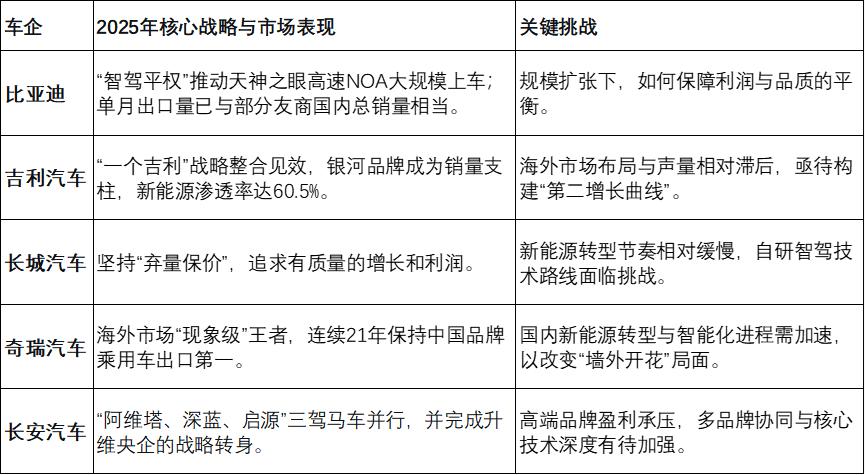
Among the “Big Five” self – owned brand camp, different strategic choices and situations emerged in 2025. The following table outlines their core characteristics:
Meanwhile, the competition among new car – making players has become increasingly fierce and highly differentiated. Leapmotor delivered over 536,000 vehicles throughout the year, a year – on – year increase of 113.42%, making it the “nine – time champion” among new players.
On the other hand, Li Auto was in the throes of transformation. The press conference of its first pure – electric SUV, the i8, sparked huge controversy due to a collision test that defied physical common sense. Subsequently, the recall of the MEGA model, combined with the pressure of operating in both extended – range and pure – electric segments, led to a “cliff – like decline” in its third – quarter performance.
Behind the drastic changes in the industry landscape are two core driving forces: the rapid spread of technology and the in – depth expansion of globalization.
In terms of technology, “intelligent driving for all” became a reality in 2025.
Represented by BYD, its high – level intelligent driving assistance system, “Heavenly God’s Eye,” has been installed in the Seagull model with a starting price of only 78,800 yuan. It is predicted that the hardware cost of highway NOA will drop to 3,000 – 5,000 yuan, and the hardware cost of urban NOA is expected to fall within the range of 1,500 – 3,000 yuan. This means that intelligent driving is rapidly changing from a high – end “show – off” feature to a common configuration for economy cars.
In more forward – looking technology fields, the 9 cutting – edge and 9 innovative technologies selected at the 2025 World New Energy Vehicle Conference pointed the way. From Huawei’s “megawatt charging technology” to the “full – domain AI large model for new energy batteries,” the focus of industrial innovation has gone beyond electrification itself and delved into the underlying levels of energy, algorithms, and chips.
In terms of globalization, China’s auto exports have achieved a qualitative change from “product going global” to “industry rooting overseas.” In the first 11 months, the export volume of new energy vehicles reached 2.315 million units, doubling year – on – year.
The export model is no longer simple trade. In places like Thailand, led by complete vehicle manufacturers such as BYD and Great Wall, power battery companies like CALB and Gotion High – Tech, as well as parts giants like Ningbo Tuopu, have followed to build factories, forming an industrial chain cooperation model of “complete vehicles leading, parts following, and service supporting.”
In 2025, while the market scale of China’s new energy vehicle industry continued to expand, it was undergoing a profound reshaping driven by the change in capital logic. The industry competition has shifted from the early “financing – expansion” scale competition to a new stage where companies win the favor of capital through technological depth, profit models, and ecological value.
Notably, the capital market has become more rational. During the year, companies in the industrial chain flocked to list on the Hong Kong Stock Exchange. Chery Automobile ended its 21 – year journey to go public, and the value of its deep – seated manufacturing system and overseas channels was re – evaluated; Seres achieved A + H listing through its in – depth cooperation with Huawei in the smart – selected vehicle model, indicating that the “technology + manufacturing” integration model has been recognized by capital; Brands like Avita Technology are seeking independent listings to open up financing channels to cope with the high cost of intelligent R & D.
The core logic behind this wave of listings is that the industry is shifting from relying on venture capital for “survival by transfusion” to financing through the public market for “self – improvement” to support long – term technological investment and global expansion. Companies must prove their sustainable profit paths and growth potential to more rational public investors.
Meanwhile, the role of state – owned capital has undergone a strategic upgrade. The restructuring and upgrading of Changan Automobile into the third automobile central enterprise after FAW and Dongfeng is of symbolic significance.
This move means that state – owned capital has shifted from being a policy supporter and financial investor in the past to an active industry integrator and strategic stabilizer. Its main goals are to guide resources to tackle “bottleneck” technologies such as intelligent chips and operating systems; to suppress the disorderly price war and excessive involution in the market; and to inject certainty into the industry’s basic R & D and supply – chain security with a longer – term perspective and greater perseverance, thus shaping a healthier and more resilient industrial ecosystem.
More fundamentally, the boundaries of the industry are blurring, and ecological competition is emerging.
The core of the automotive value chain is rapidly shifting from traditional manufacturing to “electrical and electronic architecture – software – data – service.” Li Auto released AI glasses deeply integrated with the in – car system, aiming to upgrade the cockpit into a super – terminal for the personal AIoT ecosystem; XPeng demonstrated flying cars and planned for robots, which is an extension of its intelligent technology in multi – dimensional travel scenarios.
The in – depth involvement of technology giants such as Huawei and Xiaomi is not only about “making cars” but also about redefining the architecture and experience of cars. The automotive industry is evolving into an open – ecological platform integrating energy, semiconductors, artificial intelligence, and mobile services.
In 2025, when China’s new energy vehicle industry was advancing by leaps and bounds, the underlying structural challenges in the industry were becoming the key factors affecting its direction and endurance.
The sustainable leadership of the industry depends not only on technological innovation and market expansion but also on repairing the fragile symbiotic relationships in the industry, adhering to the bottom line of business integrity, and building systematic competitiveness for the future.
The primary hidden danger lies in the increasingly tense supply – chain relationships. Under the pressure of the intense “price war,” some OEMs have randomly transferred the cost pressure to upstream suppliers, resulting in an excessive extension of the payment period for suppliers, especially small and medium – sized enterprises. This has seriously squeezed their survival and R & D space, eroded the foundation of product quality, and shaken the trust basis for industrial collaborative innovation.
To address this, the state revised regulations, clearly mandating that the payment period for large, medium, and small enterprises should not exceed 60 days. This “anti – involution” measure aims to reverse the zero – sum game and promote the industry to build a healthy ecosystem with shared risks and benefits, recognizing that only a stable supply – chain foundation can ensure the continuous prosperity of vehicle brands.
Another prominent issue is the disconnection between exaggerated marketing and the actual product. Under the anxiety of competition, some companies have used exaggerated or misleading promotions that violate basic common sense to cover up technological or definitional shortcomings. Such actions seriously overdraw consumer trust and damage the long – term credibility of brands. As a large – scale durable consumer good, the automotive market is built on a solid reputation, and any short – sighted “marketing tricks” may cause a backlash far greater than short – term traffic gains.
Looking to the future, the industry needs to undergo profound transformation in three dimensions:
First, build a resilient supply – chain community. Leading companies should regard the supply chain as strategic partners and build a flexible network capable of jointly coping with risks and collaborating on innovation through data sharing, joint R & D, and even capital ties, shifting from cost – squeezing to value co – creation.
Second, promote technological innovation from application integration to underlying breakthroughs. The competition is shifting from electrification assembly to original innovation in the intelligent era. The key to victory lies in continuous investment in underlying technologies such as intelligent chips, vehicle – operating systems, vehicle – road – cloud integration, and next – generation batteries, which is crucial for the ultimate competitiveness of the country’s high – end manufacturing industrial chain.
Third, complete the transformation of globalization from “product export” to “ecosystem rooting.” Going global should be upgraded from trade and local production to “localization of brand and ecosystem.” This requires companies to deeply integrate into the local market, establish a local system covering R & D, services, and recycling, and transform from “Chinese global companies” to “true global companies.”
The changes in capital and the ecosystem in 2025 indicate that the competition in China’s new energy vehicle industry has entered the “second half.”
The rationalization of the capital market forces companies to prove their sustainable profitability; the upgrade of state – owned capital aims to shape a more orderly and resilient industry landscape; and the boundary – less ecological competition opens up infinite imagination space but also brings more complex challenges.
In this value re – evaluation, the ultimate winners will not only be the sales champions but also the true giants that can define the next – generation technological standards, control the core nodes of the ecosystem, and achieve a closed – loop business model.
* The pictures are from the Internet. Please contact us for deletion if there is any infringement.
This article is from the WeChat official account “Insight New Research Society” (ID: DJXYS – 0309), written by Chen Wen and published by 36Kr with authorization.
该文观点仅代表作者本人,36氪平台仅提供信息存储空间服务。
36kr Europe (eu.36kr.com) delivers global business and markets news, data, analysis, and video to the world, dedicated to building value and providing business service for companies’ global expansion.
© 2024 36kr.com. All rights reserved.