Europe’s battery electric car market closes 2025 at a 19% average, up 4 percentage points from 2024 – International Council on Clean Transportation
Press release
January 25, 2026
Automakers are on track to reach the next CO₂ target in 2027, remaining 4 grams of CO2 per kilometer from full compliance. The Volkswagen pool is the furthest away from the target but cut its gap in half in 2025.
Battery electric and plug-in hybrid cars together topped 50% of sales in the Nordic countries and the Netherlands in 2025. Among Europe’s largest markets, Germany and France reached 30% and 27%, respectively, while Italy and Spain are catching up at 12% and 20%, respectively.
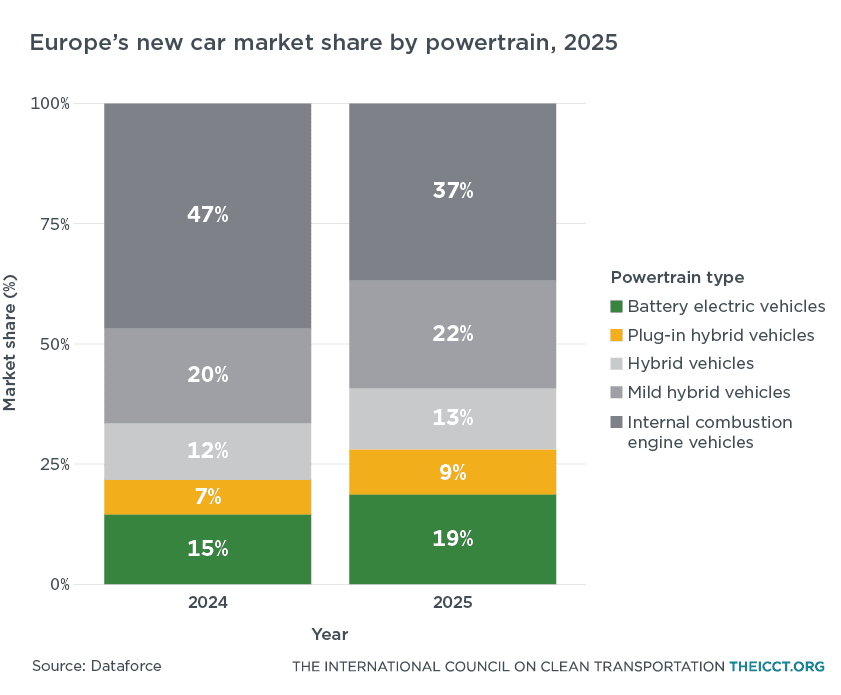
Berlin, 26 January — Europe’s battery electric car market reached a historic milestone in 2025, with fully electric vehicles comprising nearly one in five new cars sold. Battery electric cars accounted for 19% of new car registrations across Europe, up 4 percentage points from 2024 and the highest annual share ever recorded. Despite political and economic uncertainty, 2025 marked the strongest year-on-year growth since 2021.
This expansion was the main driver behind falling average CO₂ emissions from new car registrations, bringing automakers significantly closer to their next regulatory targets for the 2025–2027 compliance period. Overall, the European car market grew by 2.2% compared with 2024, reaching approximately 11 million units, of which over 2 million were battery electric. Battery electric car registration volumes increased by about 31% in 2025 compared with 2024.
“The 2025 data shows that Europe’s car market continues to electrify at pace, even amid regulatory and geopolitical uncertainty,” said Sonsoles Díaz, ICCT Senior Researcher. “Electric vehicles are no longer a niche segment, and consumers are responding to the market supply—– their market share is 4 points up while combustion engines’ share is 10 points down.”
Throughout 2025, Europe experienced intense political debate over the pace of the transition to electric mobility, driven by economic pressures, tariff threats, and rising international competition in the automotive sector. Early in the year, the European Union introduced additional regulatory flexibility, allowing automakers to average their fleet emissions over a longer compliance period (2025–2027), effectively easing short-term pressure and delaying the 2025 target for two years.
While this change likely slowed electric vehicle uptake, the market continued to expand. Battery electric and plug-in hybrid vehicles together reached a combined 28% market share in 2025—an increase of 6 percentage points compared with 2024. Over the same period, conventional internal combustion engine vehicles lost 10 percentage points of market share, while full and mild hybrids gained 3 percentage points.
“Greater compliance flexibility likely reduced the incentive for carmakers to accelerate the rollout of more affordable and attractive electric models,” said ICCT Europe Director Peter Mock. “Especially during the first half of 2025, while a relaxation of the target was under political discussion, electric vehicle uptake turned out to be slow. This demonstrates the importance of regulatory certainty in shaping long-term investment decisions and the availability of electric vehicles on the market.”
Carmakers closing the compliance gap
To meet their 2025–2027 CO₂ targets, automakers are permitted to combine their emissions performance through pooling arrangements and to use compliance credits. Taking these flexibilities into account, manufacturing pools remained on average at 97g CO₂/km in 2025, just 4 grams from their average target for the 2025–2027 period.
Rising BEV sales are the main factor behind this rapid catch-up from a 10 g/km gap at the beginning of the year, highlighting the effectiveness of EU emission regulations in steering market outcomes. Europe’s five largest carmakers’ groups by sales volume—Volkswagen, BMW, Mercedes-Benz, Stellantis, and Renault—all increased their BEV market shares in 2025, with the strongest gains coming from Volkswagen Group (+7 percentage points), followed by the Renault and BMW groups, which each gained 5 percentage points. Stellantis and Mecedes-Benz increased 3 and 0.4 points, respectively.
Table. Electric car share of top 7 car manufacturers groups in Europe, 2025 vs 2024
The BMW and Mercedes-Benz pools are already meeting or exceeding their average targets two years ahead of schedule. The Volkswagen pool remains the furthest from its target, at 8 g CO₂/km above target, but its strong BEV growth in 2025 helped reduce the gap by around 9 g CO₂/km over the course of the year. The Renault pool and the Tesla pool (which includes Stellantis) are both just 3 g CO₂/km from their targets.
“The data confirms that Europe’s largest carmakers are on a credible path to compliance. Mercedes and BMW are already there, while others are closing the gap quickly thanks to accelerating electric sales. The expected release of new, more affordable electric car models this year and past carmakers’ strategies indicate that the next targets are within reach if the regulatory framework remains stable,” said Mock.
Electrification advances across Europe
Car electrification is progressing across all regions of Europe. Nordic countries and the Netherlands have already surpassed a 50% electric market share, largely driven by battery electric cars. Among Europe’s largest markets, Germany and France reached a combined battery electric and plug-in hybrid market share of 30% and 27%, respectively, while Italy and Spain are catching up at 12% and 20%, respectively.
Battery electric car growth remains the key driver of Europe’s electric car market, reaching 19% in Germany and 20% in France. In Germany, this represents a 43% increase compared with 2024, with nearly 55,000 battery electric cars registered in December alone.
Several smaller markets are already ahead of the European average BEV market share of 19%, including Belgium (34%), Luxembourg (27%), Portugal (23%), and Austria (21%). Spain, Italy, and Poland remained below a 10% battery electric car market share in 2025 but recorded strong growth in registration volumes compared with 2024, rising by 77%, 46%, and 163%, respectively.
European Market Monitor Cars and Vans: January-December 2025
January 25, 2026
Join our mailing list to keep up with ICCT’s latest research and analysis.
Contact Us
We use cookies to improve site functionality and make this website more useful to visitors. Find out more.
This website uses cookies to enable some basic functionality and also to help us understand how visitors use the site, so that we can improve it.
Essential cookies provide basic core functionality, such as saving user preferences. You can disable these cookies in your browser settings.
We use Google Analytics to collect anonymous information about how visitors interact with this website and the information we provide here, so that we can improve both over the long run. For more on how we use this information please see our privacy policy.