Ferrari 'more united than ever' as Hamilton drives new F1 car after troubled 2025 – bastillepost.com
Font Size
Sport
FIORANO MODENESE, Italy (AP) — Team principal Fred Vasseur says Ferrari is “more united than ever” as Lewis Hamilton test drove the car designed to bring the Italian giant back to the front of the Formula 1 field following a troubled 2025.
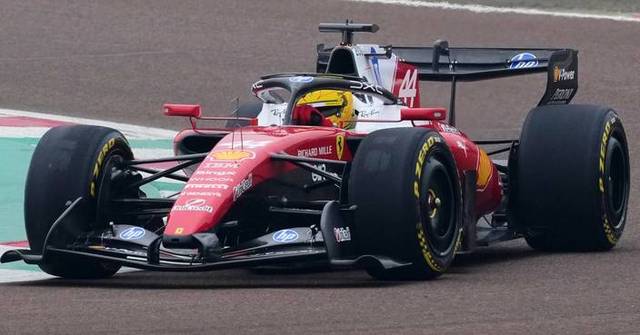
Hamilton was at the wheel as the SF-26 took to Ferrari’s Fiorano test track on a cool, damp winter’s day for brief “shakedown” runs Friday ahead of the start of official F1 preseason testing next week in Spain.
Click to Gallery
One of the biggest regulation changes in F1 history could offer Ferrari the chance to move on from a difficult 2025 season in which Hamilton and teammate Charles Leclerc failed to win a single Grand Prix. In his debut season with Ferrari, seven-time champion Hamilton didn’t even make a Grand Prix podium — a first for his career — though he did win a sprint race.
“This car is the result of a tremendous team effort and represents the start of a completely new journey, built around a different set of rules that inevitably brings a number of unknowns,” Vasseur said. “The team is aligned and more united than ever as we look ahead to the season.”
Ferrari’s lack of success in 2025 had given rise to speculation over Vasseur’s place as team principal before he was handed a contract extension in July with emphatic backing from Ferrari management.
Hamilton said it’s been “a particularly fascinating challenge” to develop the SF-26, especially as the rules have changed to mandate smaller, lighter cars with a crucial role for electrical power.
“The 2026 season represents a huge challenge for everyone, probably the biggest regulation change I have experienced in my career,” Hamilton said Friday. “When a new era begins everything revolves around development, growth as a team, and moving forward in the same direction.”
The first race of the new season is the Australian Grand Prix on March 8.
AP auto racing: https://apnews.com/hub/auto-racing
Britain’s Lewis Hamilton steers his Ferrari Formula One SF-26 at the Ferrari private test track, in Fiorano Modenese, Italy, Friday, Jan. 23, 2026. (AP Photo/Antonio Calanni)
Britain’s Lewis Hamilton steers his Ferrari Formula One SF-26 at the Ferrari private test track, in Fiorano Modenese, Italy, Friday, Jan. 23, 2026. (AP Photo/Antonio Calanni)
Britain’s Lewis Hamilton steers his Ferrari Formula One SF-26 at the Ferrari private test track, in Fiorano Modenese, Italy, Friday, Jan. 23, 2026. (AP Photo/Antonio Calanni)
Britain’s Lewis Hamilton steers his Ferrari Formula One SF-26 at the Ferrari private test track, in Fiorano Modenese, Italy, Friday, Jan. 23, 2026. (AP Photo/Antonio Calanni)
Britain’s Lewis Hamilton steers his Ferrari Formula One SF-26 at the Ferrari private test track, in Fiorano Modenese, Italy, Friday, Jan. 23, 2026. (AP Photo/Antonio Calanni)
PARIS (AP) — Paris men’s Fashion Week has been arguing for a new kind of authority this season — coat-first.
Across the runways, statement outerwear, bigger shoulders and sharp tailoring have been doing the work, turning familiar staples — trench coats, suits, denim and workwear — into clothes with a harder stance.
With the fashion week heading into its final stretch, the common thread is a push to make menswear more protective, performance-minded and built for real life, without losing the showmanship that defines Paris.
That argument landed most clearly at Dior Men, where Jonathan Anderson bent classic codes into new proportions, and Louis Vuitton, where Pharrell Williams framed luxury as practical convenience — heritage shapes upgraded with weatherproofing, reflectivity, reversibility and engineered comfort.
Other designers from Ami Paris to Rick Owens, Yohji Yamamoto and IM Men at Issey Miyake worked along the same lines: rebuild the shoulder, reshape the body, and lean into the idea of uniform — not as costume, but as modern equipment.
Paris menswear is also being driven by celebrity gravity, the kind that turns a runway into a global moment within minutes.
Dior’s room was packed with VIPs including Robert Pattinson, Lewis Hamilton and SZA.
Louis Vuitton delivered a front row mixing music, film and online fame — SZA, Usher, Future and Jackson Wang among them — plus a runway cameo from BamBam of GOT7.
The clothes are the product, but the frenzy is amplified by who is watching, who is posting, and who is seen.
Instead of chasing novelty for its own sake, many designers are taking familiar silhouettes and making them perform.
At Vuitton, Williams’ show was filled with recognizable pieces — double-breasted suits, blousons, polished outerwear; then the twist arrived in the materials and construction.
Tailoring carried reflective elements for night visibility.
Jackets turned into water-repellent hybrids.
Fabrics were lightened, waterproofed and sometimes embellished with crystal details that mimicked raindrops.
Accessories followed the same logic: caps designed to be crushed and returned to shape; shoes built to flex more like sneakers while still reading as traditional footwear.
The message was clear: luxury is not only a look. It is also capability.
Across brands, the silhouette focus moved upward. The shoulder became the season’s main design focus — where structure, protection and attitude all meet.
Anderson’s Dior treated tailoring history as a series of pivots.
Jackets nodded to the 1940s and early 1960s, then were cut abruptly short or shrunken to expose the hipbone.
Ordinary pieces were pushed into new scale — including a round-neck sweater extended to ankle length.
Throughout, he made the familiar feel new by changing proportion, fabric or what it was paired with.
IM Men also leaned into shoulder architecture, remixing outerwear by blending storm flaps into trench coats and amplifying volume.
Yohji Yamamoto used padding along arms and legs to give different bodies a similar shape, then controlled that bulk with buttons and adjustable details.
Even when designers disagreed on mood — sharp, romantic, severe, strange — they converged on shape: the body is being redesigned.
There has also been a clear emotional undercurrent: protection. Paris is dressing men for a world that feels harder, more uncertain, and more public.
Rick Owens described thinking about police uniforms and the impulse to mock a threat as a way of processing it.
His runway delivered skinny foundations, then added cropped jackets, tactical hybrids, leather and Kevlar-like materials, and ambiguous details that hinted at insignia without turning into costume.
His question — “sheriffs or outlaws?” — captured the season’s tension between authority and rebellion.
Yamamoto also drew from army and working clothes, but described a softer kind of protection: enveloping layers meant to endure long stretches outdoors.
IM Men’s draped, layered looks pushed a related idea, less militant than nomadic: clothing as shelter.
For all the experimentation, the week has not abandoned everyday dressing.
Ami Paris’ anniversary show was built on an idea of real Parisian style — camel coats, stripes, denim, clean tailoring — then refined through better proportion and styling.
The clothes were designed to mix easily, with small shifts that made them feel current: longer coats that sit better on the shoulder and cleaner lines.
The takeaway is that the daily wardrobe still matters, but it is being tightened and upgraded.
Dries Van Noten sharpened that idea with color and craft. Julian Klausner built the show around “coming of age” — men leaving home in hand-me-down coats, then made knitwear the engine, from structured-shoulder cardigans to patterned collar pieces on narrow coats and cloaks.
He also brought kilts and skirt-like belted layers back into the mix.
Saturated, pattern-heavy coats — including Polaroid florals and patchworked panels — showed how Paris can make a wardrobe feel new through layering, proportion and finish.
Many of the season’s strongest statements have come from styling as much as garments.
At Dior, Anderson’s “anti-normal” attitude appeared in wild wigs and ruff collars that turned what was formal and old into something sharp and slightly dangerous.
At Vuitton, the styling did the opposite — staying restrained — while letting materials and construction carry the message: classic shapes, but built for movement and weather.
While Dior and Vuitton set the tone, the rest of the schedule reinforced it in different registers — wearability with precision at Ami, confrontation and control at Owens, protection through layering at Yohji, and sculpted outerwear at IM Men.
With the week ending Sunday, the final shows will decide whether this season’s turn toward function and shape becomes a deeper shift — or remains a Paris moment where luxury briefly proved it can be practical, too.
A model wears a creation as part of the Issey Miyake Fall/Winter 2026-2027 Men’s collection presented in Paris, Thursday, Jan. 22, 2026. (AP Photo/Aurelien Morissard)
A model wears a creation as part of the Dries Van Noten Fall/Winter 2026-2027 Men’s collection presented in Paris, Thursday, Jan. 22, 2026. (AP Photo/Aurelien Morissard)
A model wears a creation as part of the Louis Vuitton Fall/Winter 2026-2027 Men’s collection presented in Paris, Tuesday, Jan. 20, 2026. (AP Photo/Thomas Padilla)
A model wears a creation as part of the Dior Fall/Winter 2026-2027 Men’s collection presented in Paris, Wednesday, Jan. 21, 2026. (AP Photo/Aurelien Morissard)
Models wear creations as part of the Louis Vuitton Fall/Winter 2026-2027 Men’s collection presented in Paris, Tuesday, Jan. 20, 2026. (AP Photo/Thomas Padilla)
© 2023 Bastillepost. All rights reserved.
© 2026 Bastillepost. All rights reserved.