TESTED: The Smart car that can swallow a Fortwo and outpace an M2 – Autocar
How we test cars
Recently, we brought you road tests of a pure Mercedes (the CLA) and of a pure Geely (the EX5), which got us wondering where this week’s road test subject, the Smart #5 sits.
Smart, in its current form, is a joint venture between Mercedes and Geely, with production in China but engineering and development by mixed teams. That has so far resulted in the #1 and #3. Now it has come up with its third model, the #5 (yes, Smart is sticking with the hashtag thing), which arrives in the ultra-busy and ultra-competitive electric D-SUV segment, otherwise known as the Tesla Model Y class. In its current form, Smart has yet to set the sales charts on fire. It probably doesn’t help that many people still associate the brand with tiny city cars, and neither the #1 nor the #3 was a standout car – solid but unremarkable three-and-a-half-star products with pleasant but slightly anonymous styling.
On paper, at least, the #5 could be a big step forward. Most testers were quite taken with the SUV’s chunky design, and it comes with some impressive technical trump cards. All but the entry-level version get 800V architecture, 400kW charging and a huge, 100kWh battery – the biggest in the class. We’re testing the long-range, single-motor version to see if it really can stand out with more than its specs and to find out how much of it is Geely and how much of it is Mercedes.
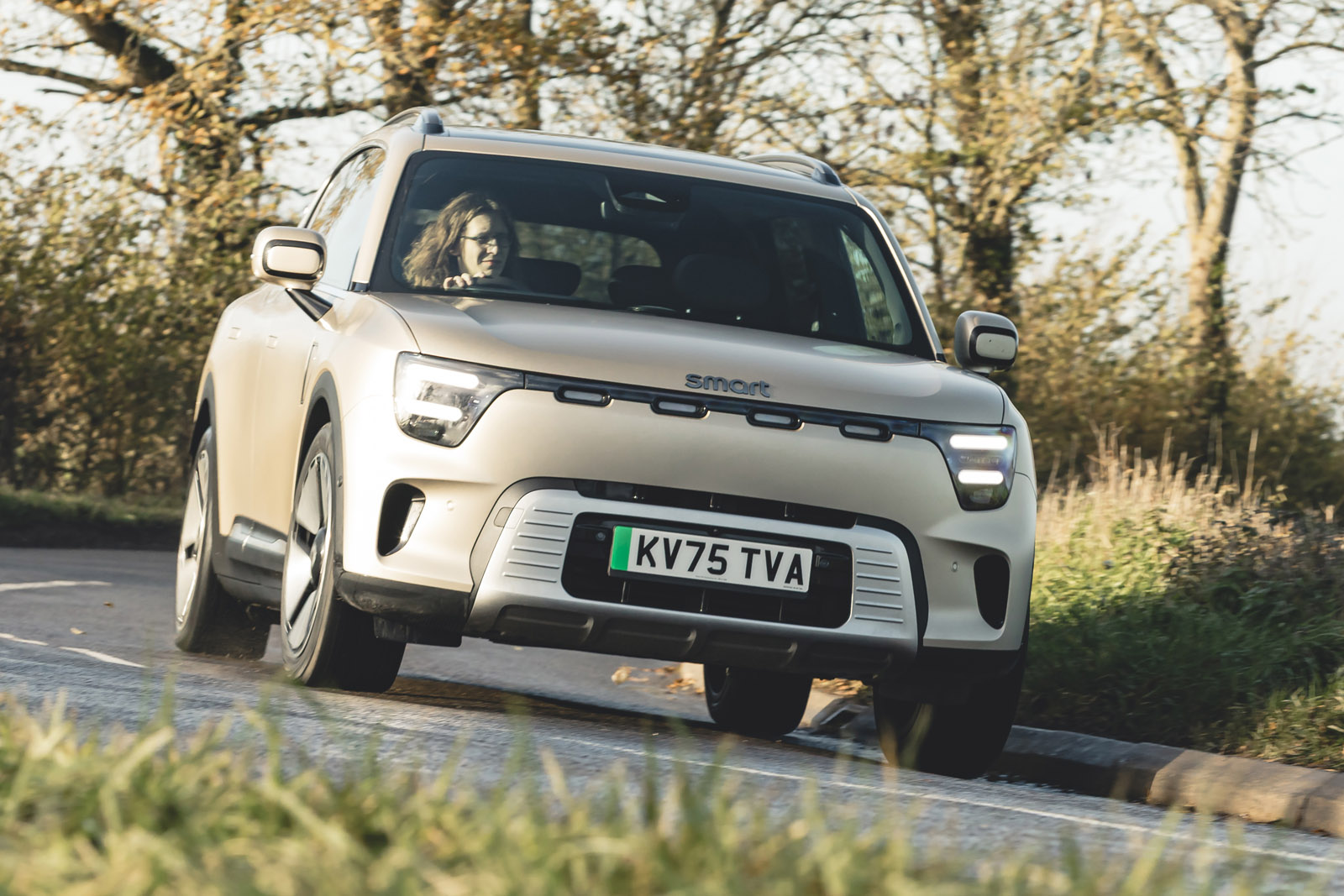
Even though Smart is a separate brand from Mercedes, the exterior designs of its current range do take after the products from Stuttgart. The #1 and #3 have light bars and surfacing that are reminiscent of the Mercedes EQ models. Smart hasn’t gone for generic aero-blob styling on the #5; the boxy SUV proportions mean it could have been the next EQB. There’s a new four-oval motif on the front and rear ends that adds a bit of texture, the big aero-disc wheels give it quite a confident stance and the near-vertical rear window reminded some testers of the second-generation ‘bustleback’ Renault Mégane.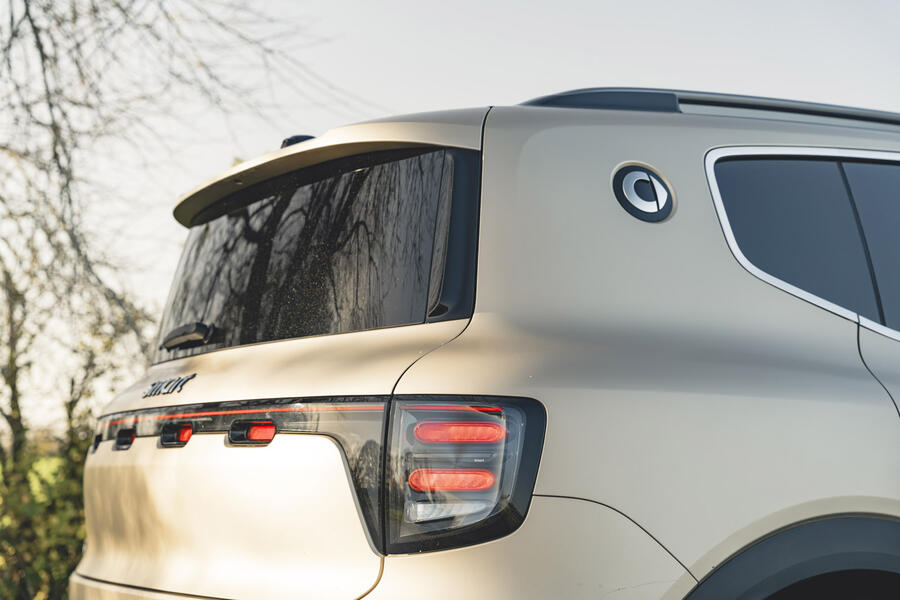
When many sport ‘utility’ vehicles are trading boot space for a sloping roofline, it gives the #5 a useful amount of versatility. The upright appearance makes the #5 quite deceptive in terms of size. Although it looks like it might be a competitor for seven-seaters like the Peugeot e-5008 and Kia EV9, it is actually substantially shorter than a Tesla Model Y (4692mm versus 4790mm) and even a bit lower (1705mm versus 1711mm).
The #5’s architecture is an evolved version of the one underpinning the other modern-day Smart cars, as well as the Volvo EX30, Polestar 4 and a number of others. One of the big advances is that it is now suitable for both 400V and 800V electrical systems, depending on the trim level. Smart offers the #5 in a wide range of trims. Entry-level Pro sticks with much the same technical specs as the #1 and #3, so 400V, a single 335bhp rear motor, a 62kWh nickel-manganese-cobalt battery and 150kW rapid charging. Pro+ brings the same level of equipment but gets you the 800V upgrade. This comes with a much bigger battery of 94.0kWh usable capacity, a more powerful 358bhp motor and, notably, 426kW rapid charging. Premium, like our test car, is mechanically the same but adds more equipment. Pulse and Summit gain a front motor for four-wheel drive. And for anyone who still finds 479bhp too weedy, there’s the Brabus with a ludicrous 637bhp.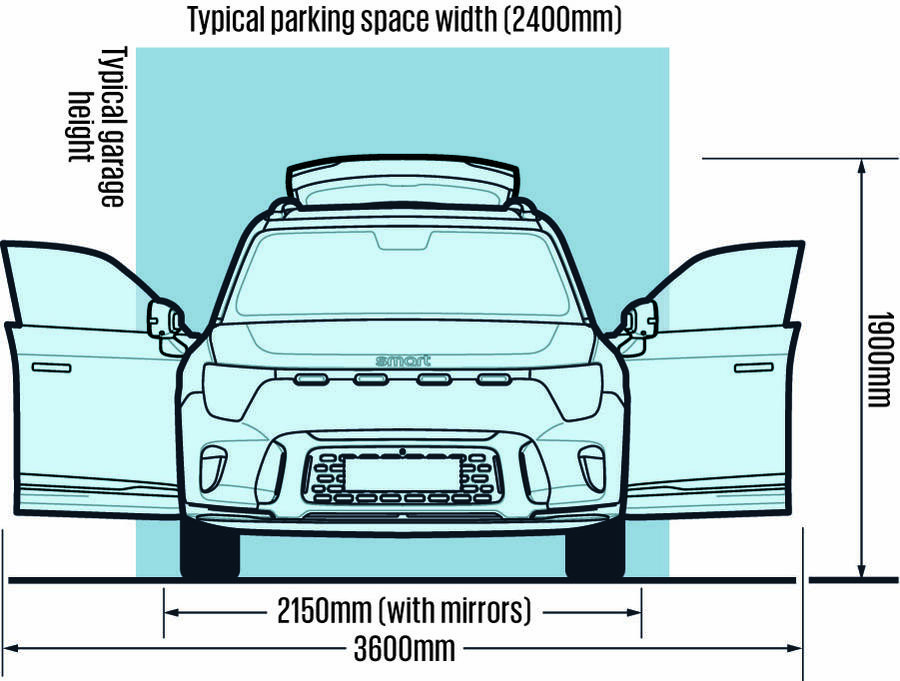
Smart makes no mention of any major chassis upgrades for the Brabus, and its 21in wheels are shod with Continental EcoContact tyres like the rest of the range, so it should be viewed as the inordinately fast version rather than the keen driver’s choice. All #5s ride on steel coils with passive dampers with the classic combination of MacPherson struts up front and a multi-link in the back. That big battery does make the #5 pretty heavy: 2293kg on our scales is nearly 400kg more than the long-range single-motor Model Y. Then again, it’s only 30kg more than a standard-range Peugeot e-3008.
Even more so than the exterior design of the #5, its interior wouldn’t look out of place in a Mercedes showroom. The rounded centre console, the floating armrests on the door cards, the door-mounted seat controls and the centre screen and passenger screen combo are all straight out of the Mercedes design manual. That’s not meant as a criticism at all.
Compared with recent Mercedes, Smart even adds some extra flourishes like the plus-shaped air vent controls and a mushroom-shaped central speaker that rises up when the car turns on. Furthermore, the genuine brown leather and wood trim provide balance to the front-and-centre tech to make this cabin one that is inviting in an old-school way, without turning into some painful pastiche of the past. The Smart even has one over some recent Mercedes in featuring a reasonable selection of physical buttons.
Unfortunately, the Geely influence does come through in some of the control layout. Although it has lost the cartoon characters and distracting graphics of the #1 and #3, the touchscreen interface has plenty of undesirable traits that we have also observed in a number of Chinese cars. While the screen is massive, many of the on-screen icons are quite small and therefore difficult to hit while driving. Curiously, some functions are doubled up, while others, such as the heated steering wheel, require a deep menu dive. Of course, there is always voice control, which works reasonably well. There is lots of small text and little in the way of customisation to let you put the information and functions that you find useful on the home screen. Some of the menu structures could also benefit from some optimisation and we remain unconvinced of the usefulness of a passenger touchscreen.
Wireless phone charging and mirroring are all present and correct, as you would expect. While the #5 may be a smaller car than it looks, it seems to try to make up for that with its accommodation. The driving position is relatively high but feels natural and there is plenty of adjustment in the steering column. Rear leg room of 830mm beats even Tesla’s Model Y, though it does suffer from the EV-typical high floor.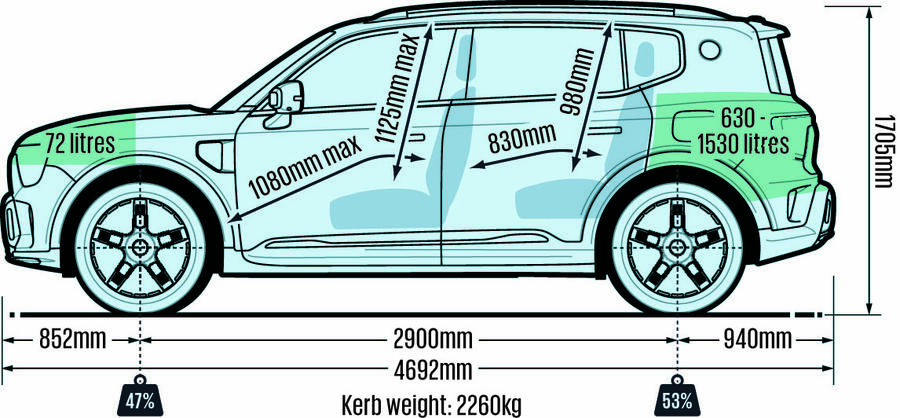
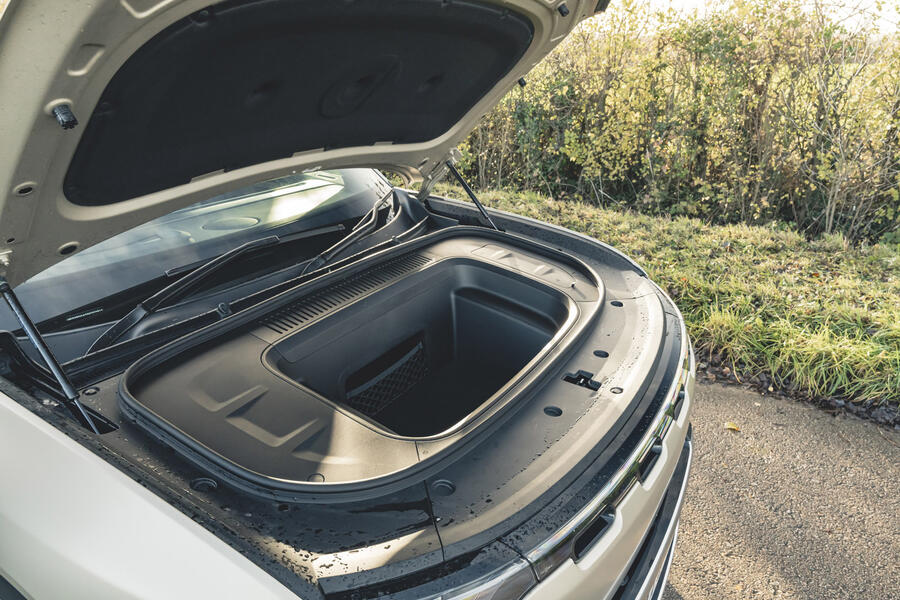
While the backrest reclines electrically, a sliding function would have been more useful in order to be able to trade some of that leg room for extra boot space. Not that there’s much to complain about in that area. The 630 litres on offer is very generous indeed, and there is a further 72 litres in the frunk. The rear seats can easily be folded flat using the pair of levers, if you need even more space. One caveat is that some of those 630 litres are under the floor in a slightly awkwardly shaped well. The floor can be moved to a lower position, but this creates a very uneven floor. Still, this is clearly one of the more practical options in the class.
Whichever #5 you pick, you won’t be short of performance. We have previously tested the entry-level Pro and the Brabus. The former still delivers 335bhp to the rear axle for 0-62mph in a more than satisfactory 6.9sec. The latter’s nausea-inducing, Lamborghini Urus-baiting 637bhp is little more than a gimmick you will try once, before realising that no family car needs to be that accelerative.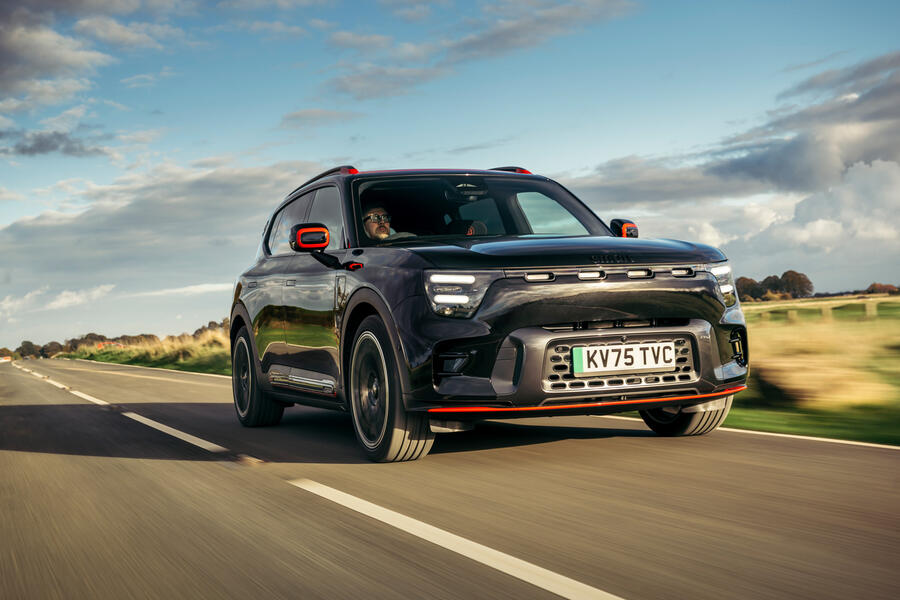
We have now performance tested the Premium, which has slightly more power than the Pro, mainly to compensate for the additional weight of its bigger battery. Despite damp conditions, it beat its claimed 6.5sec 0-62mph time, regardless of its state of charge. That 6.3sec time is very slightly slower than the long-range Tesla Model Y. The Smart maintains its acceleration even at high speeds, and it’s slightly quicker than the Tesla to 120mph. It’s undoubtedly helped in this pursuit by its shorter rear-axle ratio (11.0:1 versus 9.1:1), a design choice that may come to haunt it when we get to discussing running costs.
Much like other cars on the SEA platform, however, the Smart #5 suffers from iffy drivability. There is always a delay to the response of the accelerator pedal, both when accelerating and when using off-throttle regen. This means your right foot is chasing a moving target, making it difficult to be smooth. You often press the pedal too hard because the car isn’t accelerating the way you expect, then have to back off as it catches up.
The same effect happens in reverse with the regen, which can’t be turned off completely. This is a problem we also found with the Geely EX5, even if it isn’t as severe with the Smart, particularly if you select the low regen and Eco drive modes. There is a one-pedal mode, dubbed S-Pedal, which brings the car to a complete stop, but because it is so hard to be smooth with it, it’s next to unusable. The deceleration it delivers is also relatively weak.
The brake pedal is actually nicely progressive, and the emergency stopping distances we recorded are quite good. Our ‘dry’ stopping distances were recorded on a damp surface, but a fully wet stopping distance of 53.4m from 70mph is very good. For comparison, the BMW i4 needed 58.2m. This is also in spite of the test car wearing mismatched tyres. We presume it suffered a puncture before our loan and its front Continental EcoContact 7 tyres were replaced with EcoContact 6Q MO.
Test conditions 9deg C, dampStanding quarter mile 14.2sec at 108.9mph Standing km 25.2sec at 125.8mph 30-70mph 4.3sec 50-80mph 3.5sec 0-62mph 6.3sec
Tesla Model Y Long Range Rear-Wheel Drive (2025, 22deg C, dry)Standing quarter mile 14.2sec at 103.6mph Standing km 25.5sec at 126.1mph 30-70mph 4.3sec 50-80mph 4.0sec 0-62mph 5.9sec
Dry 60-0mph 2.91sec (damp)
Wet 60-0mph 2.77sec
You wouldn’t expect the different front and rear tyres to do the #5’s handling any favours, but then they are quite similar compounds. Beyond that, the car’s relatively simple mechanical layout of a single rear motor, passive suspension, 47:53 weight distribution, relaxed steering ratio and the same-size front and rear tyres give it an enjoyably fluent handling balance.
Make no mistake: this is not a driver’s car and nor is it meant to be one, but its chassis feels well matched to its mission. The relatively soft suspension allows a fair amount of body roll, but it builds progressively, and because the steering is moderately sped, at 2.7 turns lock to lock, the driver’s inputs are slowed down and unlikely to overwhelm the chassis. At 11.2m, the turning circle is fairly tight for a big car, though the single-motor version isn’t any better in this respect than the dual-motor ones.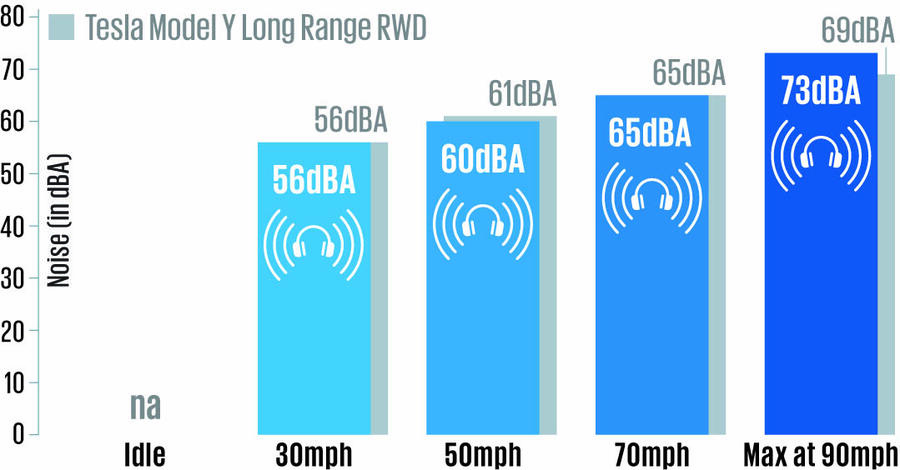
The steering ultimately lacks some feedback to really inspire confidence. With power going exclusively to the rear axle, there’s no unseemly scrabbling or torque steer, and unless you’re being particularly ham-footed, the traction control is subtle and responsive enough to allow for quick getaways from slippery junctions. On Horiba MIRA’s handling circuits, we discovered that the stability control can be disabled completely, which means that this sensible family car can be held in extended drifts. The delayed accelerator response makes such endeavours a little challenging but still quite amusing.
The same softish suspension gives the #5 a nicely relaxed long-wave ride, without disintegrating into floatiness like we observed with the Geely EX5. Even so, it lacks a final layer of sophistication in terms of its secondary isolation. The 20in wheels thump clumsily through potholes and over expansion joints, and there’s a low-level rumble over some surfaces that isn’t loud and therefore didn’t seem to affect our noise readings but is noticeable.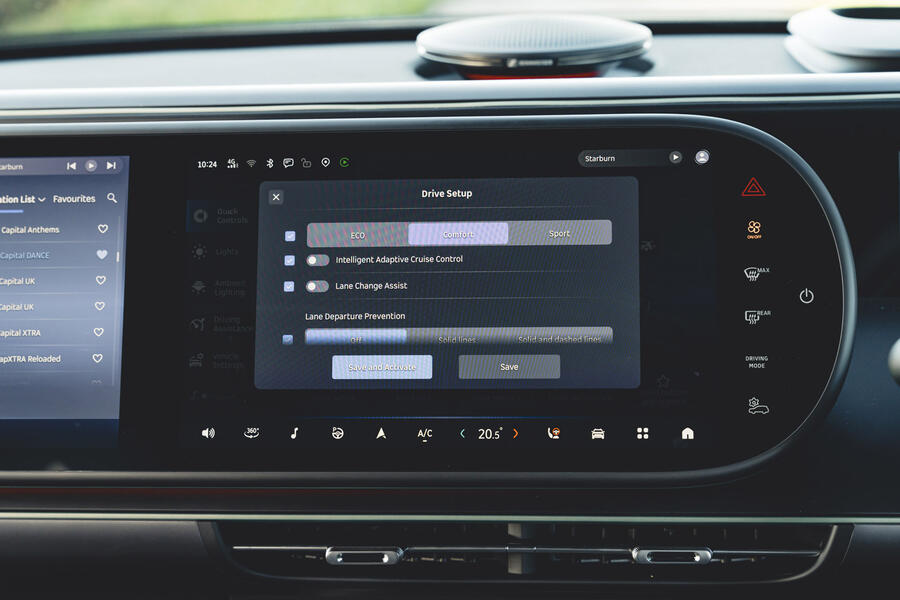
Although the #5’s chassis seems to have quite a bit of Mercedes in it, it appears suggests the assisted driving side was – regrettably – left to Geely. The adaptive cruise control defaults to Pilot Assist, which steers for you, and not very competently. In general, it’s too keen to brake for cars in front, not smooth and too slow to accelerate. There also doesn’t seem to be a resume function; instead it always adopts what it thinks is the speed limit. At one point, presumably when the cameras were dirty, it refused duty entirely.
The mandatory functions are typically irritating, and even the blindspot monitoring – usually one of the few useful assistance systems – is overly sensitive and will turn down your music while it beeps. There is – almost – a saving grace, because there is a Renault-style custom settings mode, which lets you disable most of the systems with a press of a physical button and one tap of the screen. Trouble is, it doesn’t include the overspeed warning, which has to be disabled separately, deep in a sub-menu.
The big highlight of the Smart #5’s technical specification is that 426kW rapid-charging figure. The fastest charger we could find was rated for 400kW, and we suspect it wasn’t quite putting out that much. Even so, the Smart reached a peak of 375kW, and was still pulling 179kW at 80% state of charge. That’s a very impressive performance, and meant its 94kWh battery could be recharged from 10-90% in just 21 minutes.
Even if sufficiently fast chargers were more common than they currently are, a lot of the charging speed’s positive effect on journey times is undone by the #5’s disappointing efficiency, and therefore range. You would expect the 94kWh battery to be one of the car’s greatest strengths, but sub-standard efficiency means that, at 366 miles, it actually has 21 fewer miles of WLTP range than the Tesla Model Y, which has a much smaller battery.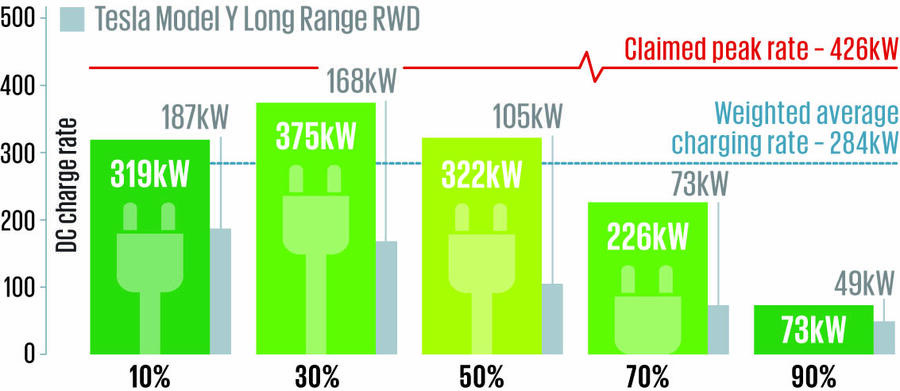
Measuring efficiency was fraught, because not only did our test car display its efficiency in kWh/100 miles, but the figure was also wrong. We supposedly averaged 1.4mpkWh, which was clearly at odds with the car’s range. Smart confirmed that this was due to a miscalculation in the conversion from kilometres to miles. One of the menus also displayed the kWh used over a certain period, which worked out to 2.5mpkWh. That’s still very poor, even for winter conditions, and gives a range of 233 miles, which seems consistent with what we were getting. We didn’t manage to record reliable figures for our usual touring and ‘everyday’ economy tests.
Prices start at £39,800 for the Pro. Premium, like our test car, would seem like the sweet spot thanks to its larger battery and generous level of spec. At £47,300, it’s cheaper than a Model Y Long Range RWD, though the Tesla has much more attractive finance rates.
The #5 is easily the most likeable modern-day Smart yet. In many ways, it feels like a Mercedes with a dose of extra cheer and youthfulness, thanks to interesting design details and attractive materials. This certainly makes it a more characterful way of getting about than the robotic Tesla. It is also highly practical, especially for its size, it’s pleasant to drive and it charges quickly.
Unfortunately, there are a few too many rough edges. Most notably, it squanders its advantage of a huge battery and very fast charging with terrible efficiency. This means range is far behind the best in the class and running costs will be elevated. Add in poor ADAS, and it means the #5 is likely to struggle in what is a highly competitive segment.
Smart is clearly heading in the right direction, but it feels overdue for a breakthrough car.
As a road tester, Illya drives everything from superminis to supercars, and writes reviews and comparison tests, while also managing the magazine’s Drives section. Much of his time is spent wrangling the data logger and wielding the tape measure to gather the data for Autocar’s in-depth instrumented road tests.
He loves cars that are fun and usable on the road – whether piston-powered or electric – or just cars that are very fit for purpose. When not in test cars, he drives an R53-generation Mini Cooper S or a 1990 BMW 325i Touring.
Felix is Autocar’s deputy editor, responsible for leading the brand’s agenda-shaping coverage across all facets of the global automotive industry – both in print and online.
He has interviewed the most powerful and widely respected people in motoring, covered the reveals and launches of today’s most important cars, and broken some of the biggest automotive stories of the last few years.